
Fact Sheet FS1051
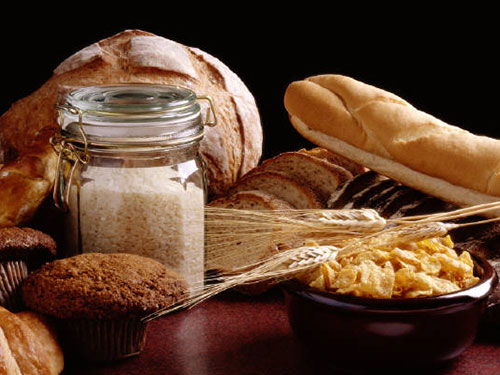
Any food made from wheat, rice, oats, cornmeal, barley or another cereal grain is a grain product. Bread, pasta, oatmeal, breakfast cereals, tortillas, and grits are examples of grain products. Grains are divided into 2 subgroups, whole grains and refined grains.
Whole grains contain the entire grain kernel - the bran, germ, and endosperm. Examples include:
- whole-wheat flour
- bulgur (cracked wheat)
- oatmeal
- whole cornmeal
- brown rice
Refined grains have been milled, a process that removes the bran and germ. This is done to give grains a finer texture and improve their shelf life, but it also removes dietary fiber, iron, and many B vitamins. Some examples of refined grain products are:
- white flour
- degermed cornmeal
- white bread
- white rice
Check the ingredient list for the words "whole grain" or "whole wheat" to decide if they are made from a whole grain. Some foods are made from a mixture of whole and refined grains. Some grain products contain significant amounts of bran. Bran provides fiber, which is important for your health. However, products with added bran or bran alone (e.g., oat bran) are not necessarily whole grain products.
Some Less Common Grains
- Amaranth – amaranth plants are classified as pseudocereals that are grown for their edible starchy seeds, but they are not in the same botanical family as true cereals.
- Millet – a cereal plant with numerous small seeds, which are used to make flour.
- Quinoa – a pseudocereal plant grown for its edible seeds, which are high in protein, dietary fiber, B vitamins and dietary minerals.
- Sorghum – a nutrient-packed grain that is rich in vitamins and minerals like B vitamins, magnesium, potassium, phosphorus, iron, and zinc. It's also an excellent source of fiber, antioxidants, and protein.
- Triticale – known for being a hybrid of wheat and rye with the health benefits of both yet is higher in protein than wheat.
How Many Grain Foods Are Needed Daily?
The amount of grains you need to eat depends on your age, gender, and level of physical activity. Recommended daily amounts are listed in the chart. Most Americans consume enough grains, but few are whole grains. At least ½ of all the grains eaten should be whole grains.
| Daily Recommendation** | Daily minimum amount of whole grains | ||
|---|---|---|---|
| Children | 2–3 years old | 3-ounce equivalents** | 1 ½ ounce equivalents** |
| 4–8 years old | 4–5-ounce equivalents** | 2–2 ½ ounce equivalents** | |
| Girls | 9–13 years old | 5-ounce equivalents** | 3-ounce equivalents** |
| 14–18 years old | 6-ounce equivalents** | 3-ounce equivalents** | |
| Boys | 9–13 years old | 6-ounce equivalents** | 3-ounce equivalents** |
| 14–18 years old | 7-ounce equivalents** | 3 ½ ounce equivalents** | |
| Women | 19–30 years old | 6-ounce equivalents** | 3-ounce equivalents** |
| 31–50 years old | 6-ounce equivalents** | 3-ounce equivalents** | |
| 51+ years old | 5-ounce equivalents** | 3-ounce equivalents** | |
| Men | 19–30 years old | 8-ounce equivalents** | 4-ounce equivalents** |
| 31–50 years old | 7-ounce equivalents** | 3 ½ ounce equivalents** | |
| 51+ years old | 6-ounce equivalents** | 3-ounce equivalents** | |
| **WG = whole grains | |||
Grains can be considered in ounce equivalents. What is an ounce equivalent? See the chart below.
What Counts as an Ounce Equivalent of Grains?
In general, 1 slice of bread, 1 cup of ready-to-eat cereal, or ½ cup of cooked rice, cooked pasta, or cooked cereal can be considered as a 1-ounce equivalent from the grains group.
| Amount that counts as 1 ounce equivalent of grains | Common portions and ounce equivalents | ||
|---|---|---|---|
| Bagels | WG**: whole wheat RG*: plain, egg | 1 "mini" bagel | 1 large bagel = 4-ounce equivalents |
| Biscuits | baking powder/ buttermilk— RG* | 1 small (2" diameter) | 1 large (3" diameter) = 2-ounce equivalents |
| Breads | WG**: 100% Whole wheat RG*: white, wheat, French, sourdough | 1 regular slice 1 small slice French 4 snack-size slices rye bread | 2 regular slices = 2-ounce equivalents |
| Bulgur | cracked wheat WG** | ½ cup cooked | |
| Cornbread | RG* | 1 small piece (2 ½" x 1 ¼" x 1 ¼") | 1 medium piece (2 ½" x 2 ½" x 1 ¼") = 2-ounce equivalents |
| Crackers | WG**: 100% whole wheat, rye | 5 whole wheat crackers 2 rye crispbreads | |
| RG*: saltines, snack crackers | 7 square or round crackers | ||
| English Muffins | WG**: whole wheat RG*: plain, raisin | ½ muffin | 1 muffin = 2-ounce equivalents |
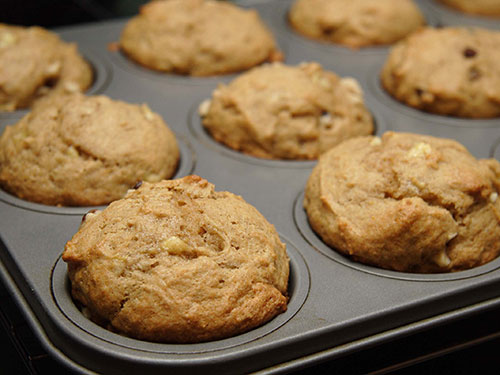
| Muffins | WG**: whole wheat RG*: bran, corn, plain | 1 small (2 ½" diameter) | 1 large (3 ½" diameter) = 3-ounce equivalents |
| Oatmeal | WG** | ½ cup cooked 1 packet instant 1 ounce dry (regular or quick) | |
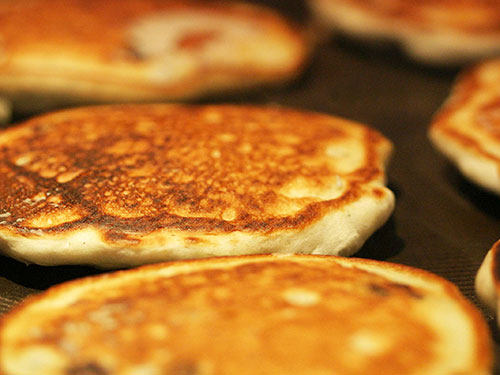
| Pancakes | WG**: Whole wheat, buckwheat RG*: buttermilk, plain | 1 pancake (4 ½" diameter) 2 small pancakes (3" diameter) | 3 pancakes (4 ½" diameter) = 3-ounce equivalents |
| Popcorn | WG** | 3 cups, popped | 1 microwave bag, popped = 4-ounce equivalents |
| Ready-to-eat breakfast cereal | WG**: toasted oat, whole wheat flakes RG*: corn flakes, puffed rice | 1 cup flakes or rounds 1 ¼ cup puffed | |
| Rice | WG**: brown, wild RG*: enriched, white, polished | ½ cup cooked 1 ounce dry | 1 cup cooked = 2-ounce equivalents |
| Pasta - spaghetti, macaroni, noodles | WG**: whole wheat RG*: enriched, durum | ½ cup cooked 1 ounce dry | 1 cup cooked = 2-ounce equivalents |
| Tortillas | WG**: whole wheat, whole grain corn RG*: Flour, corn | 1 small flour tortilla (6" diameter) corn tortilla (6" diameter) | 1 large tortilla (12" diameter) = 4-ounce equivalents |
| **WG = whole grains, *RG = refined grains. This is shown when products are available both in whole grain and refined grain forms. | |||
Nutritional Value of Grains
Grains are important sources of many nutrients, including dietary fiber, several B vitamins (thiamin, riboflavin, niacin, and folate), and minerals (iron, magnesium, and selenium).
Dietary fiber from whole grains, as part of an overall healthy diet, helps reduce blood cholesterol levels and may lower the risk of heart disease.
Fiber is important for proper bowel function. It helps reduce constipation and diverticulosis. Fiber-containing foods such as whole grains help provide a feeling of fullness with fewer calories. Whole grains are good sources of dietary fiber; most refined (processed) grains contain little fiber.
Vitamins (thiamin, riboflavin, niacin, and folate) play a key role in metabolism – they help the body release energy from protein, fat, and carbohydrates. B vitamins are also essential for a healthy nervous system. Many refined grains are enriched with these B vitamins.
Folate (folic acid), another B vitamin, helps the body form red blood cells. Women of childbearing age who may become pregnant and those in the first trimester of pregnancy should consume adequate folate, including folic acid from fortified foods or supplements. This reduces the risk of neural tube defects, spina bifida, and anencephaly during fetal development.
Iron is used to carry oxygen in the blood. Many teenage girls and women in their childbearing years have iron- deficiency anemia. They should eat foods high in heme-iron (meats) or eat other iron containing foods along with foods rich in vitamin C, which can improve absorption of non-heme iron. Whole and enriched refined grain products are major sources of non-heme iron in American diets.
Whole grains are sources of magnesium and selenium. Magnesium is a mineral used in building bones and releasing energy from muscles. Selenium protects cells from oxidation. It is also important for a healthy immune system.
What to Look for on the Nutrition Facts Food Label
Choose foods that name one of the following whole-grain ingredients first on the label's ingredient list: brown rice, bulgur, graham flour, oatmeal, whole grain corn, whole oats, whole rye, whole wheat or wild rice.
Foods labeled with the words "multi-grain," "stone-ground," "100% wheat," "cracked wheat," "seven-grain," or "bran" are usually not whole-grain products. Color is not an indication of a whole grain. Bread can be brown because of molasses or other added ingredients. Read the ingredient list to see if it is a whole grain. Use the Nutrition Facts label and choose products with a higher % Daily Value (%DV) for fiber – the %DV for fiber is a good clue to the amount of whole grain in the product.
Read the food label's ingredient list. Look for terms that indicate added sugars (sucrose, high-fructose corn syrup, honey, and molasses) and oils (partially hydrogenated vegetable oils) that add extra calories. Choose foods with fewer added sugars, fats, or oils.
Most sodium in the food supply comes from packaged foods. Similar packaged foods can vary widely in sodium content, including breads. Use the Nutrition Facts label to choose foods with a lower % DV for sodium. Foods with less than 140mg of sodium per serving can be labeled as low sodium foods. Claims such as "low in sodium" or "very low in sodium" on the front of the food label can help you identify foods that contain less salt (or sodium).
Whole Grain Tips for Children
- Set a good example for children by eating whole grains with meals or as snacks.
- Let children select and help prepare a whole grain side dish.
- Teach older children to read the ingredient list on cereals or snack food packages and choose those with whole grains at the top of the list.
Health Benefits
- Consuming foods rich in grains, as part of a healthy diet, reduces the risk of coronary heart disease.
- Consuming foods rich in fiber, such as whole grains, as part of a healthy diet may reduce constipation.
- Eating at least 3-ounce equivalents a day of whole grains may help with weight management.
More Information
July 2025
Copyright © Rutgers, The State University of New Jersey. All rights reserved.
For more information: extension.rutgers.edu.
Cooperating Agencies: Rutgers, The State University of New Jersey, U.S. Department of Agriculture, and Boards of County Commissioners. Rutgers Cooperative Extension, a unit of the Rutgers New Jersey Agricultural Experiment Station, is an equal opportunity program provider and employer.