
Fact Sheet FS1089
Use of the backyard grill or barbecue to prepare meals on hot summer evenings and for holiday picnics is as American as apple pie. Grilling not only helps to keep the heat out of the kitchen, but it is also a fun and tasty way to serve up favorites such as grilled fish and chicken. Grilling is also an opportunity for foodborne illness if food is not cooked properly. According to the Centers for Disease Control and Prevention (CDC), approximately 48 million people get sick because of a food-borne illness each year. In addition to this, ongoing evidence suggests that cooking certain foods at high temperatures may result in other health risks. Following food safety guidelines carefully before, during, and after grilling to prevent food-borne illness and limit health risks is an important part of grilling with care.
Before Grilling
Keep all the perishable foods that are headed for the grill cold until you are ready to prepare them. This is an important step in avoiding food-borne illness. Here are some reminders:
- Transport cold food home from the store in a cooler with ice packs
- Refrigerate within 2 hours when the outdoor temperature is below 90 ℉
- Refrigerate within 1 hour when the outdoor temperature is above 90 ℉
- Keep cold foods at 40 ℉ or below until it is time to place them on the grill
- Defrost meat, fish, or poultry in the refrigerator on a plate to catch any drippings
If you like to marinate your food before grilling to enrich its flavor or to tenderize it, remember to:
- Always marinate food in the refrigerator
- Discard any marinade that has been used on meat, fish or poultry
- Marinade that has not been in contact with raw meat, fish or poultry or boiled used marinade can be used later on the cooked food.
Choosing what to put on the grill has taken on new importance according to top cancer prevention experts from the World Cancer Research Fund (WCRF) and the American Institute for Cancer Research (AICR). A recent report from these organizations suggests that diets high in red meat including beef, pork, and lamb, and processed meats such as hot dogs, may be linked to cancer of the colon. As a result of this report, recommendations include:
- Limiting processed meats
- Limiting red meat to 12–18 ounces (cooked) each week
- Choose more plant-based foods
Although these recommendations include some grilling favorites, choosing more poultry, fish, fruits, and vegetables for the grill may lead to some new favorites. For example, try Grilled Peaches and Goat Cheese Salad (recipe included) served over brown rice for a delicious summer treat.
During Grilling
To continue grilling with care, be sure to cook meat, fish, and poultry to a safe internal temperature to destroy harmful bacteria. This cannot be done by looking at the food. Due to the high heat of the grill, foods often cook faster on the outside and may look done before they truly are. To be sure it is done on the inside, use a food thermometer.
| Food | Temperature |
|---|---|
| Fish | 145°F |
| Steaks & Roasts | 145°F |
| Ground Meat | 160°F |
| Pork | 145°F |
| Poultry, including ground | 165°F |
The high heat of the grill is also responsible for flare-ups that can cause the outside of food to become charred. Some studies suggest that there may be a risk of cancer when protein foods such as meat, poultry, or fish are cooked at high temperatures. Researchers know that certain cancer-causing substances are formed during grilling and other high heat cooking methods. Some of these substances are produced in "muscle meats" such as red meat, poultry, game and fish during high-heat cooking methods. Others are formed when the fat drips onto the hot stones or coals of the grill, accumulating onto the food when smoke and flare-ups occur.
As a result, experts recommend that we:
- Eat moderate amounts of grilled protein foods
- Avoid charring of grilled protein foods
Partial cooking of food in the microwave, in the oven or on the stove will help to reduce grilling time and decrease the opportunity for charring. This method can be used safely if the food is taken from the precooking source and placed directly onto the grill to complete cooking. All perishable foods should be cooked thoroughly with minimal interruption to avoid the development of harmful bacteria. Additional suggestions to keep grilling safe are found in the box, Tips for Grilling with Care.
After Grilling
Once food has reached a safe minimum internal temperature and is removed from the grill:
- Place on a clean platter, assuring it is not placed on the plate that held the raw meat, poultry or fish
- Keep food hot at 140 ℉ or above until served
- Refrigerate cooked items within 2 hours in mild weather
- Refrigerate cooked items within 1 hour when the outside temperature is at 90 ℉ or above.
Tips for Grilling with Care
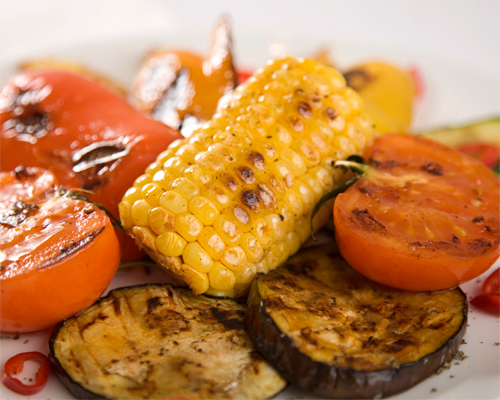
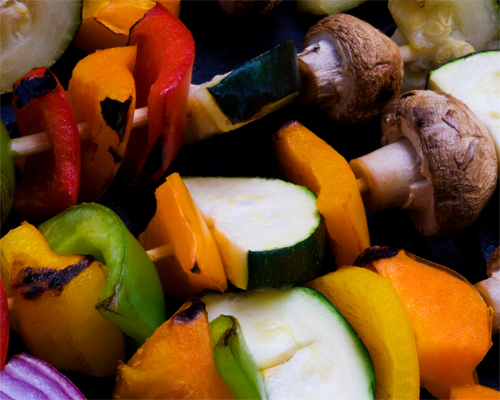
- Grill more vegetables and fruits
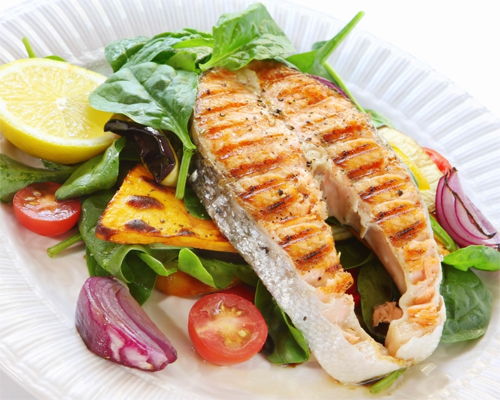
- Choose poultry breast and fish over beef, pork and lamb
- Marinate protein foods before grilling and turn them frequently to reduce the production of cancer-causing substances
- Reduce flare-ups by spreading aluminum foil on the grill, making small holes in the foil to allow fat to drain
- Pre-cook protein foods before grilling to shorten grilling time
- Choose lean cuts to decrease fat drippings on the coals
- Cook in the center of the grill and move coals to the side to keep fat from dripping on them
- Grill smaller portions to decrease the exposure time to high heat
- Remove and discard any charred portions on protein foods
- "Barbecue" in the oven anytime of the year by spreading your favorite sauce on chicken breasts or lean chops and bake until done
Check these sites for more information:
- American Institute for Cancer Research Grilling and Cancer Risk
- American Institute for Cancer Research Recipes
- Centers for Disease Control-Food Safety
- Food Safety and Inspection Service-USDA
Recipe
Try this recipe from the American Institute for Cancer Research to see how delicious grilled peaches can be!
Grilled Peaches and Goat Cheese Salad
Ingredients
- Cooking spray
- 1/4 cup balsamic vinegar
- 2 Tbsp. honey
- 3 medium peaches, pitted and cut into 6 wedges
- 1 Tbsp. extra virgin olive oil
- Salt and freshly ground black pepper, to taste
- 10 cups arugula, loosely packed
- 4 Tbsp. goat cheese
Directions
Prepare grill to high heat. Spray grill rack with cooking spray and set aside. In a small saucepan over medium-high heat, bring vinegar to a boil. Reduce heat and simmer until vinegar is reduced to 2 tablespoons (about 2 minutes). Remove from heat and stir in honey. Cool to room temperature. Place peach wedges on grill rack. Grill 30 seconds on each side or until grill marks appear, but peaches are still firm. Remove from grill and set aside. In a large bowl, combine oil, salt and pepper. Add arugula, tossing gently to coat. Arrange arugula mixture on platter. Top with peach wedges, balsamic syrup and cheese.
Notes
You can add a handful of walnuts to the salad for an extra crunch and boost of copper and manganese, along with high amounts of polyphenols (phytochemical) that have antioxidant properties.
Nutritional Information
Makes 5 servings (1 ½ cups per serving). Per serving: 120 calories, 4.5 g total fat (1.5 g saturated fat, 0 g trans-fat), 5 mg cholesterol, 20 g carbohydrates, 3 g protein, 2 g dietary fiber, 40 mg sodium, 17 g sugar, 7 g added sugar.
April 2026
Copyright © Rutgers, The State University of New Jersey. All rights reserved.
For more information: extension.rutgers.edu.
Cooperating Agencies: Rutgers, The State University of New Jersey, U.S. Department of Agriculture, and Boards of County Commissioners. Rutgers Cooperative Extension, a unit of the Rutgers New Jersey Agricultural Experiment Station, is an equal opportunity program provider and employer.