

Fact Sheet FS1291
When making better lifestyle choices, people commonly rely on eating healthier and exercising more. Making changes to your beverage choices is important as well. Reducing the amount of sugar-sweetened beverages you drink can save anywhere between 200 to 2,000 calories per day.
According to the Centers for Disease Control (CDC), sugar-sweetened beverages are the largest source of sugar in the American diet. They have also been linked to Type 2 diabetes, tooth decay and cavities, kidney diseases, heart disease and weight gain/obesity. Sugar-sweetened beverages include any beverages that use added sugar (i.e., iced teas, specialty coffee beverages, juices, soft drinks, and flavored waters). In addition to sugar, fat that is included in beverages can also increase calories.
How Much Is Too Much?
The American Heart Association (AHA) recommends limiting added sugars to no more than half of your daily discretionary calorie allowance. For most American women, that’s no more than 100 calories per day, or about 25 grams, or 6 teaspoons of sugar. For men, it’s 150 calories per day, or about 36 grams/9 teaspoons of sugar. The AHA recommendations focus on all added sugars, without singling out a particular type, such as cane, high-fructose corn syrup, or dextrose.
Making a "Simple Change"
You can build a better beverage by reducing sugar, fat, and calories with simple changes. Replacing just one 12 oz. soft drink per day with water can save 14,235 grams of sugar, or 56,940 calories per year. Even making minor changes like replacing whole milk or cream with nonfat or reduced-fat milk; using fewer sugar packets; or both can save upwards of 100 calories per beverage. Use our tips and tricks below to build a healthier version of your favorite beverage.
What About Diet Beverages?
Diet beverages are the common go-to for someone hoping to wean off of sugar-sweetened beverages. But are they necessarily better? Certainly they don't contain the sugar and calories of their counterparts, but that doesn't mean that they are automatically healthy. Current scientific research on the risk of artificial sweeteners varies. Some recent studies suggested that diet soda may lead to a lowered risk of obesity when used as a substitute for regular soda, but the ultimate recommendation is to be mindful and consume in moderation.
Sugar substitutes are commonly listed in drinks as either: aspartame, neotame, sucralose, and/or saccharin.
Soft Drinks
Soft drinks are a common source of added sugar. Research shows a direct link between obesity risk and soft drink consumption, due to high sugar content. Some research also suggests that fructose consumption can potentially be linked to increased food consumption and weight gain. What can you substitute instead?
- Switch to regular or flavored seltzer water to have the fizz without the additives. Making the change from a 16-ounce orange soda to 16-ounce orange sparkling water saves 216 calories and over 57 grams of sugar (equivalent to 14¼ teaspoons of sugar).
- Drink water and add fruit for flavor. Some water bottles even have built-in diffusers to make adding lemons, limes, or other fruit/vegetables easy.
- If you do crave a soft drink fix on occasion, opt for the mini cans (7-8 ounces). Switching from a 16 fl oz. to a 7.5 fl oz. serving will save 97 calories and 26 grams of sugar (equivalent to 6½ teaspoons of sugar).
Dairy-based Beverages
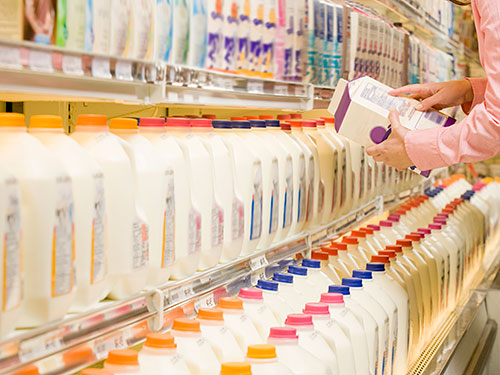
Dairy foods are the top source of calcium in the American diet; they’re also an excellent source of high-quality protein, which assists in muscle development. However, flavored dairy-based beverages can be high in fat, calories and sugar. Even dairy alternatives such as almond, rice, coconut, cashew, and soy milks can be high in added sugar and sometimes fat. But luckily there are options to reduce fat, added sugar, and calories without sacrificing protein and calcium.
Tricks to choosing a better dairy or dairy alternative:
| Type (per 1 cup) | Calories | Fat |
|---|---|---|
| Half and Half | 320 | 28g |
| Whole Milk | 150 | 8g |
| 2% Milk | 130 | 5g |
| 1% Milk | 110 | 2.5g |
| Non-Fat Milk | 90 | 0g |
From: ndb.nal.usda.gov/ndb, horizon.com
- Use lower fat dairy options, such as 1% reduced-fat or non-fat milk. Even a switch from half-and-half to whole milk can save 2.5 grams of fat and 21 calories per 2 tablespoons. See Table 1 to see how your dairy stacks up…and identify how to reduce calories and fat.
- Avoid flavored milk and milk alternatives that have added sugar and calories.
- When choosing dairy alternatives (such as almond, rice, coconut, cashew or soy milk) beware of products that are low in protein or contain added sugars. Select dairy alternatives that match your calorie, protein, and calcium needs without the added sugar. Use Table 2 to compare different varieties without added sugars.
| Type (per 1 cup) | Calories | Fat | Saturated Fat | Sugar (total) | Protein | Calcium |
|---|---|---|---|---|---|---|
| Silk® Unsweetened Soymilk | 80 | 4g | 0.5g | 1g | 7g | 300mg |
| Silk Unsweetened Almondmilk | 30 | 2.5g | 0g | 1g | 1g | 450mg |
| Silk Unsweetened Cashewmilk | 25 | 2g | 0g | 0g | <1g | 450mg |
| Rice Dream™ Unsweetened Rice Milk | 70 | 2.5g | 0g | <1g | 0g | 250mg |
| Silk Unsweetened Coconutmilk | 45 | 4g | 3.5g | 7g | <1g | 450mg |
From: silk.com, horizon.com, dreamplantbased.com
Caffeinated Beverages
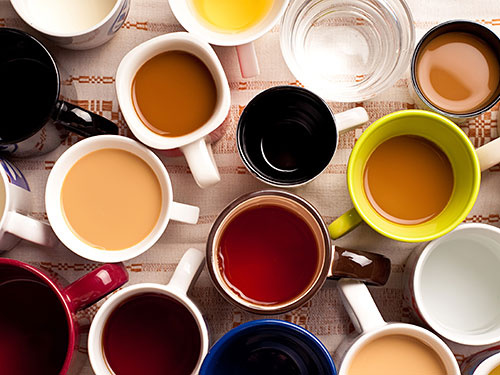
Caffeine is a staple in many morning routines, sometimes even extending throughout the day. What was once a traditionally simple cup of coffee can now contain up to 200-500 calories. From canned cold brews and bottled iced teas to colorfully packaged energy drinks, the fat, sugar, and calorie contents of these beverages can be high. There are strategies you can use to get your morning started–without the added fat, calories, and sugar.
Coffee and Tea
- Coffee & Tea: Plain coffee and tea are sugar-, fat-, and calorie-free. Use low-fat or non-fat milk over cream to lighten.
- Flavors: Specify the number of syrup pumps you want to reduce added calories. Flavor pumps will vary, depending on the coffee shop, but fewer pumps equal less sugar. A 12-ounce drink typically contains 3 pumps of syrup–at 20 calories and 5g of sugar per pump. Request fewer pumps to save calories and sugar. There are also sugar-free syrups, made from artificial sweeteners.
- Milk/Milk Alternatives: Cut calories and fat by choosing the type of milk or milk alternative you want. If you don't specify, most coffee shops use whole milk and sweetened milk alternatives. See Tables 1 and 2 for the nutrition comparison.
- Toppings: Decline the whipped cream, syrup drizzles, and sprinkled treats that coffee shops sometimes add to top a drink.
- "Skinny" and "Light" Options: These lower-calorie versions of your favorite specialty drink use non-fat milk, replace sugar-sweetened syrups with sugar-free versions made from artificial sweeteners, and omit the toppings.
- If you are unsure how much sweetener a coffee shop uses, ask for it black and sweeten it yourself.
Bottled or Canned Coffee, Teas
- Unsweetened or lightly sweetened beverages are the best choice.
- Limit the use of artificially sweetened drinks as well.
Juices and Smoothies
Both 100% juices and smoothies can be packed with nutrients and minerals from the various fruits and vegetables they are made from. However, some can also be hidden sources of extra sugar, fat, and calories. Use these tips to guide your choices.
Smoothies
- Smoothies contain more fiber than juices. Fiber will keep you fuller for longer, aid digestion, and help make a smoothie constitute a more substantial meal or snack.
- Likewise, if making it at home, you can use a variety of add-ins (such as nut butters, flax seeds, chia seeds, avocado, and many more) to increase the nutrient content.
- Skip the frozen yogurt or ice cream. Stick with lower fat dairy, dairy alternatives, or water as your base.
- Use more vegetables than fruit.
Juices
- Choose 100% juice. Other juices contain added sugars and syrups.
- Choose vegetable-based juices.
- Cut the sugar and calories in juices by diluting with water or unsweetened seltzer.
For more tips about choosing a better smoothie, see the Rutgers Cooperative Extension fact sheets, Build a Better Smoothie and How to Squeeze the Most Nutrition Out of Your Juice.
Functional Beverages
Functional beverages include ingredients with added nutritional or other values. This encompasses sports drinks, powered water additives, energy drinks, and health shakes. Due to the additives, functional beverages claim to provide health-promoting benefits, such as more energy, a speedier recovery after workouts. Although these claims may sound appealing, some functional beverages can also be a source of added sugar and calories. It's important to read labels carefully to determine whether they're a benefit or something you're better off skipping.
Beverages and sports drinks with added electrolytes are beneficial when you're working out for extended periods of time. However, they can also be high in sugar and sodium. The added sugar and electrolytes can be beneficial for strenuous activity, where athletes excrete a significant amount of sweat and lose electrolytes. However, regular water is still sufficient for lighter activities and the typical level of exercise in which most amateur and youth athletes take part.
Likewise, drinks with added vitamins tend to be sugar-sweetened water without much value for athletic performance. If needed, vitamin supplements offer a lower sugar option.
Getting Started
Building a better beverage is an important part of pursuing a healthier lifestyle. Choosing healthier options can still be fun and flavorful when you make simple changes to your daily choices.
For More Information
Family and Community Health Sciences (FCHS) works with families, schools, and communities to promote healthy eating and active lifestyles. Visit njaes.rutgers.edu/fchs for information on all of our programs, and learn how to bring them to your school, worksite, or community organization.
References
- Centers for Disease Control and Prevention. Get the Facts: Sugar-Sweetened Beverages and Consumption. https://www.cdc.gov/nutrition/data-statistics/sugar-sweetened-beverages-intake.html. Accessed July 2017.
- Bray GA, Nielsen SJ, Popkin BM. Consumption of high-fructose corn syrup in beverages may play a role in the epidemic of obesity. American Journal of Clinical Nutrition 2004; 79:537-43.
- Pereira M. Diet beverages and the risk of obesity, diabetes, and cardiovascular disease: A review of the evidence. Nutrition Reviews 2013; 71:433-40. 10.1111/nure.12038.
Mention or display of a trademark, proprietary product, or firm in text or figures does not constitute an endorsement by Rutgers Cooperative Extension and does not imply approval to the exclusion of other suitable products or firms.
June 2018
Copyright © Rutgers, The State University of New Jersey. All rights reserved.
For more information: extension.rutgers.edu.
Cooperating Agencies: Rutgers, The State University of New Jersey, U.S. Department of Agriculture, and Boards of County Commissioners. Rutgers Cooperative Extension, a unit of the Rutgers New Jersey Agricultural Experiment Station, is an equal opportunity program provider and employer.