
Fact Sheet FS1352
Food Waste
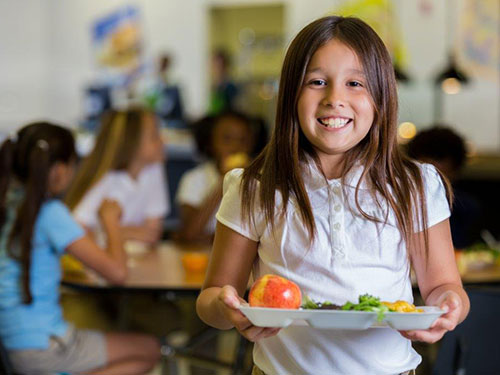
Currently, between 30–40% of the food that we produce in the United States ends up as waste.1 While food waste occurs at several sources, the USDA has identified schools as being a potential source of significant food waste reduction.2 Food waste is generally expected in schools due to varying individual food preferences and caloric needs of the student body. Additionally, students may be served food that they do not ask for or want, meaning that food is likely to end up in the trash by the end of the lunch period.
Food Insecurity
The United States Department of Agriculture (USDA) defines food insecurity as "the limited or uncertain availability of nutritionally adequate and safe foods or limited or uncertain ability to acquire acceptable foods in socially acceptable ways."3 Approximately 37 million people, including 12 million children, in the U.S. are food insecure.4 This is not because we do not have enough food to feed everyone, but rather, because we do not have food distribution systems in place that ensure equitable access to food.5
Share Tables
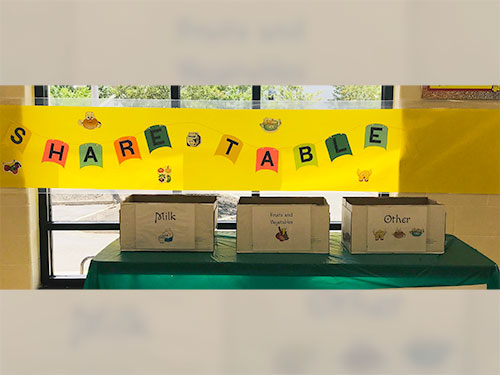
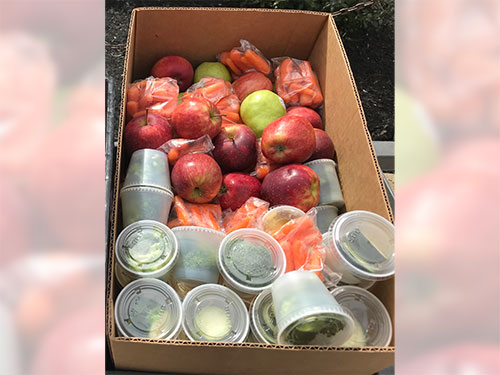
One way to address both the issue of food waste and that of food insecurity is to create a Share Table, which is a designated place in a school lunchroom where students can place unopened food and drinks that they do not consume. Any student may then take the items left on the Share Table to eat or drink later. The food on the Share Table may also be used as snacks at other times in the school day, such as after-school programs or sports practices. Alternatively, Share Table food may also be donated to local food pantries or soup kitchens.
Share Tables are relatively simple to set up and are low- or no-cost solutions to reducing waste. Schools will need a designated table or other area that is easily accessible to the students. Boxes may be set up there to keep foods separate, based on their categories (fruits, vegetables, milk, etc.). The area should have clear signs indicating that it is a Share Table, as well as brief instructions for what types of foods may be shared and designated spots for various foods (for example, all milk should go in one area and be kept cold on ice or in a refrigerator, and stay separate from fruits and other foods). Clear signage will ensure that students will easily understand where to place each item that they contribute to the Share Table.
Students, lunchroom staff, and school staff should all receive training in advance of creating a Share Table so that they understand what foods can and cannot be donated, as well as proper food safety practices.
USDA Support and Guidance
The USDA supports and encourages the use of Share Tables in school lunchrooms (see below for the USDA's guidance on Share Tables). School leaders and food service personnel may be fearful of potential liability from donating food; however, the federal Bill Emerson Good Samaritan Act protects against liability for these types of donations (see links below). Schools that wish to donate food do need to adopt and follow proper food safety protocols when donating food. See below for a sample Share Table food safety protocol.
Getting Started
If you are interested in creating Share Tables in your school, use the steps listed below to ensure that you consider all necessary steps and criteria.
BEFORE Creating a Share Table
- School district adopts a food safety protocol, which should be included in the HACCP plan (this may require action by the Board of Education).
- Consider connecting with your local health inspector to assess if your food safety protocol meets local regulations.
- Designate a staff person (either food service or school personnel) to oversee Share Table operation for each lunch period.
- Train all staff involved in Share Table operation in food safety protocols adopted by the district (Contact the RCE Food Waste Team to book a training).
- Train students in what types of foods may and may not be shared.
- Create a plan for how to use the donated food.
- Plan may include: using food for another lunch period; using food for after-school sports or other activities; sending food home with students who are experiencing food insecurity; or donating to a local soup kitchen or food pantry. See this toolkit (PDF) for more information and examples on how to use Share Table food.
CREATING the Share Table
- Designate a place in the lunchroom that can be used for the Share Table. Acquire any additional items you may need (for example: table, tub for an ice bath, refrigerator).
- Make Share Table signage that is clear and easy to read for students and staff (this is a great place to get students involved. Consider asking a class or club to create Share Table signage). Be sure to include a sign that makes clear that share tables are NOT allergy-free zones.
- Make announcements to the students on what to include in the Share Table (at least for the first few weeks until they have a solid understanding of what foods to include and not to include).
- Become familiar with proper food safety protocol. Refer to USDA's Share Table safety fact sheet.
MAINTAINING the Share Table
- Continue to communicate with staff and students about foods that may and may not be shared. This may have to be done frequently, especially when students are first learning the rules.
- Maintain records of food safety measures undertaken.
- Perform periodic assessments of the food distribution plan (using food for after-school activities, donating to a local food pantry, etc.) and revise the plan, if needed. If the food is not being used by after-school programs, for example, consider creating a backpack program to send the food home with students who may be experiencing food insecurity at home.
Share Tables are an easy, low-cost, and effective way to address food waste and food insecurity in schools and the greater community. Implementing Share Tables can save food from going to waste while also feeding those who may be food insecure within the school or greater community.
More Information
- USDA's guidance on Share Tables
- USDA guidebook on reducing food waste in schools
- Sample Share Table/food donation safety protocol (PDF)
- Rutgers Cooperative Extension School Food Waste Reduction resources
- Bill Emerson Good Samaritan Act for food donations
- Liability protection for food donations (PDF)
References
- U.S. Department of Agriculture. Food Waste FAQs.
- U.S. Department of Agriculture: Economic Research Service. Food Security in the U.S. - Measurement.
- U.S. Department of Agriculture: Economic Research Service. Food Security in the U.S. - Key Statistics & Graphics.
- Feeding America. How We Fight Food Waste in the US.
February 2023
Copyright © Rutgers, The State University of New Jersey. All rights reserved.
For more information: extension.rutgers.edu.
Cooperating Agencies: Rutgers, The State University of New Jersey, U.S. Department of Agriculture, and Boards of County Commissioners. Rutgers Cooperative Extension, a unit of the Rutgers New Jersey Agricultural Experiment Station, is an equal opportunity program provider and employer.