

Fact Sheet FS1382
Educating teens about community food systems is essential to fostering holistic, community-driven approaches to food security and sustainability. Teens are in a pivotal stage of development – shaping their identities, values, and sense of agency – making it an ideal time to engage them in food systems education. Engaging them with food systems education at this point in their lives supports personal health and empowers them to become informed, sustainable consumers and active changemakers capable of making choices that benefit their well-being, connect them to their local food environments, and acknowledge planetary health.
This resource provides educators, community-based organizations, and stakeholders with an overview of the importance of engaging teens in food systems education, identifying connections between students and their local food system, and identifying effective strategies for integrating food systems content into community programs, school curricula, and after-school activities to foster awareness, advocacy, and positive behavior changes regarding sustainable food systems.
Importance of Food Systems Education
Food systems refer to the complex networks involved in producing, processing, distributing, consuming, and disposing of food, influenced by social, economic, and environmental factors. For a deeper dive into the components and dynamics of food systems, please see the accompanying fact sheet: FS1380, Introduction to Community Food Systems.
Food systems education invites teens to explore the entire journey of food – from production to consumption to waste and disposal – and understand the deep interconnections between their choices, health, communities, and the environment. Through food literacy, teens can begin to develop essential life skills that support critical thinking, informed decision-making, and civic engagement. While many of the outcomes below are most achievable through sustained, long-term engagement, even introducing teens to the topics can spark interest and lay the foundation for future learning and leadership:
- Health and Well-being: By learning about nutritious food choices and food systems, teens are more likely to make healthier food decisions, leading to better health outcomes and increased agency to make their own food choices.
- Community Impact: Teens can actively participate in local food initiatives, such as community gardens, food banks, and food policy councils, to build meaningful connections with community agencies. These experiences not only strengthen community food systems through volunteerism but also reduce stigma around food access and foster a sense of belonging and engagement within their communities.
- Social Awareness: Through these types of education programs, teens obtain a holistic understanding of nutritional and food security disparities, particularly those found in marginalized communities.
- Critical Thinking: Teens can develop critical thinking skills by understanding complex issues such as sustainability, food security, community building, and resource management.
- Future Advocacy: Empowered teens become informed advocates for policy changes at the local and national levels, driving systemic change in food access and sustainability.
Unpacking the Food System and How It All Connects
To meaningfully engage teens in shaping the future of food systems, it’s critical to expose them to how food moves from farm to plate, including supply chains, nutrition and composting programs, consumer behaviors, and broader systemic influences such as agricultural policies, economic disparities, and social determinants of health. Emphasizing the pivotal role of nutrition in supporting lifelong health, these experiences should also foster social connection between teens and agencies. This section offers practical ways to engage young people as active participants, thereby deepening their understanding of food systems while empowering them as future leaders in health, sustainability, and social change. By examining these interconnected layers, teens are not only empowered to make informed, responsible choices, but also inspired to participate in solutions – whether through entrepreneurship, education, advocacy, or community engagement.
- Make It Real and Relatable:
Connect food topics to teens lived experiences – what they eat, where their food comes from, and how food connects to culture, identity, and community. Use scenarios, current events, and culturally relevant foods to show the impact of everyday choices. Consider incorporating social media, which can play a significant role in shaping teens’ perceptions and behaviors. Thoughtful integration of these platforms can help reinforce positive messages and support engagement with local food systems in ways that feel relevant and accessible. - Center Teen Voice and Leadership:
Invite teens to co-lead projects, mentor peers, and take part in efforts like food justice campaigns, school meal reform, or sustainable agriculture initiatives. Teen leadership fosters confidence, creativity, and deeper investment. - Design Experiential, Hands-On Learning:
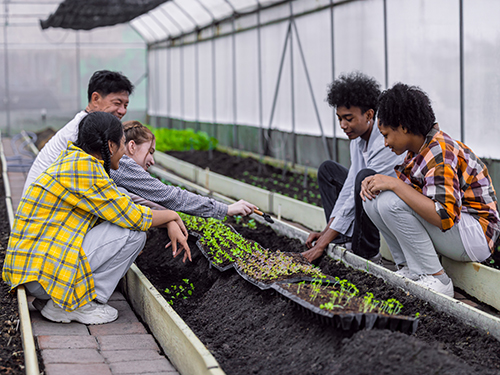
Move beyond worksheets and lectures. Incorporate gardening, cooking classes, simulations, and field trips to local farms, markets, or environmental organizations. These tactile experiences help teens internalize food systems concepts while developing life skills. Using principles of positive youth development, design a program that promotes interactive sessions and activities where teens are leading, learning, and doing. - Engage the Broader Community:
Build partnerships with local farmers, food service professionals, environmental groups, and policymakers to create meaningful learning opportunities. Community collaboration provides mentorship, deepens place-based learning, and shows teens how their efforts have real-world impact within their local community. - Leverage Technology and Creative Media:
Let teens design social media campaigns, videos, or interactive storytelling projects to advocate for food system change. Meeting teens where they are helps amplify their voice – and spreads awareness beyond the classroom. - Create Inclusive, Affirming Spaces:
Food systems education must reflect and respect the diversity of teen identities and experiences. Acknowledge different food traditions, co-create norms, and offer opportunities that empower every student to be seen and heard. - Frame Learning as Purposeful and Future-Focused:
Keeping a positive outlook throughout programming can help teens understand current food systems barriers and feel empowered to create change. Show the big picture of how food choices affect health, sustainability, security, and justice. Help inspire teens to explore career pathways in agriculture, culinary arts, food entrepreneurship, public health, and policy so they see themselves as future leaders of food system change.
Teen-Centered Approaches to Food Systems Learning
Transforming knowledge into action is where learning truly comes alive. Whether you are working with teens in classrooms, after school programs, or community-based initiatives, creating impactful experiences requires thoughtful design. The chart below identifies practical ways to engage teens in their local food system, deepening their understanding of food systems while empowering them as future leaders.
| Food Systems Sector | Engagement Strategies per Sector |
|---|---|
Food Supply Chain The food supply chain encompasses all the steps food takes from farm to table. Educating teens about this process helps them understand the complexity and interdependence of food systems. |
|
Food and Nutrition Programs Government and community-based food programs play a vital role in ensuring access to nutritious food, especially for vulnerable populations. |
|
Consumers Food Environment: Consumers influence food systems through their choices, behaviors, and advocacy. Teens can learn how their actions impact sustainability and equity, and how to impact others. |
|
Food System Drivers Food systems are shaped by a range of social, economic, environmental, and political factors. Understanding these influences helps teens grasp the broader context of food-related barriers. |
|
Educating teens about food systems is more than a lesson in agriculture or nutrition; it is an investment in the health, equity, and sustainability of our communities. By equipping teens with knowledge, skills, and opportunities to engage with food systems, we empower them to become thoughtful consumers, informed advocates, and innovative changemakers. Whether through hands-on learning, civic engagement, or leadership in local food initiatives, young people have the potential to shape a more just and resilient food future. This fact sheet offers a roadmap for educators and community leaders to guide that journey—one rooted in equity, action, and lasting impact.
References
- Allen, P., Guthman, J. 2006. From "old school" to "farm-to-school": Neoliberalization from the ground up. Agriculture and Human Values, 23(4), 401-415. DOI: 10.1007/s10460-006-9019-z
- DeJonckheere, M., Vaughn, L. M., & Bruck, D. 2017. Youth-Led Participatory Action Research : A Collaborative Methodology for Health, Education, and Social Change. SAGE Publications Ltd. DOI: 10.4135/9781473956032
- Hunger and Its Solutions in New Jersey: Landscape Analysis of Current Initiatives, Recommended Action, and Emerging Opportunities for Further Investment (PDF). 2022. Food Research and Action Center.
- Lang, T., & Barling, D. 2012. Food security and food sustainability: reformulating the debate. The Geographical Journal, 178(4), 313-326. DOI: 10.1111/j.1475-4959.2012.00480.x
- Litt, J. S., Soobader, M.-J., Turbin, M. S., Hale, J. W., Buchenau, M., & Marshall, J. A. 2011. The Influence of Social Involvement, Neighborhood Aesthetics, and Community Garden Participation on Fruit and Vegetable Consumption. American Journal of Public Health (1971), 101(8), 1466-1473. DOI: 10.2105/AJPH.2010.300111
- Nguyen, H., Neven, D. 2018. Sustainable food systems: Concept and framework. Food and Agriculture Organization of the United Nations.
- Ratcliffe, M. M., Merrigan, K. A., Rogers, B. L., & Goldberg, J. P. 2011. The Effects of School Garden Experiences on Middle School–Aged Students' Knowledge, Attitudes, and Behaviors Associated With Vegetable Consumption. Health Promotion Practice, 12(1), 36-43. DOI: 10.1177/1524839909349182
- Russ, A., Gaus, M. B. 2021. Urban Agriculture Education and Youth Civic Engagement in the U.S.: A Scoping Review. Frontiers in Sustainable Food Systems, 5. DOI: 10.3389/fsufs.2021.707896
- Singh, A., Sharma, V., Grenier, M., Singh, V., & Thakur, M. 2024. Nourishing the Future: Introduction to Sustainable Food Systems with Concepts and Framework. In: Sustainable Food Systems (Volume I). (pp. 3-24). Springer. DOI: 10.1007/978-3-031-47122-3_1
- Thakur, M. 2024. Sustainable Food Systems (Volume I): SFS: Framework, Sustainable Diets, Traditional Food Culture and Food Production. 1st ed. Springer Nature Switzerland. DOI: 10.1007/978-3-031-47122-3
December 2025
Copyright © Rutgers, The State University of New Jersey. All rights reserved.
For more information: extension.rutgers.edu.
Cooperating Agencies: Rutgers, The State University of New Jersey, U.S. Department of Agriculture, and Boards of County Commissioners. Rutgers Cooperative Extension, a unit of the Rutgers New Jersey Agricultural Experiment Station, is an equal opportunity program provider and employer.