
Fact Sheet FS607
Horse owners will usually find it necessary at some point in time to trailer their horses. Trailering may be necessary at time of purchase, for horse shows, trail riding, or a medical emergency. Whatever the need, it is important to be prepared and knowledgeable about trailering safety. Poor preparation of the horse, trailer, or towing vehicle can turn a pleasurable outing into a horse owner's nightmare. Poor truck and trailer maintenance can result in traffic accidents or breakdowns. In more extreme cases, broken welds can cause a trailer to become detached from the towing vehicle. Perhaps the most serious problem that can result from improper trailer upkeep is having a horse fall through rotted floorboards, especially during travel. This fact sheet will discuss the basic concerns involved in horse trailer maintenance and trailering safety.
When Purchasing a Horse Trailer, Consider the Following Needs:
- First, when selecting a towing vehicle, it is important to make sure that the weight of the trailer and load (horses) does not exceed that of the towing vehicle. Smaller pulling vehicles, like sport utility vehicles, have the power to “pull” the load but not to stop it, and often end up jack-knifed or in a ditch when the trailer pushes them down the road.
- Ample height (7–8 feet) and width (6–8 feet) for the horse(s) being hauled. Generally, the interior height of the trailer should be approximately 10 inches taller than the resting position of the horse's head. The width of the trailer should allow 3 inches of lateral movement on either side of the horse when loaded.
- Orientation of horses within the trailer. Trailers are available that allow horses to travel side by side on a slant, side by side without a slant, head to head, and head to tail. Each type of trailer has specific benefits, so it is important to consider each individual horse being hauled when purchasing a trailer. For example, horses riding in slant trailers seem to ride with less stress and are more stable during stops and starts than horses in an in-line or a two-horse side by side trailer.
- Location/number of ramps. Trailers with a single rear loading ramp require horses to back out of the trailer when unloading. Many trailers are available that have an additional ramp towards the front on the side of the trailer. This allows the horse to be led forward out of the trailer, which may be desirable for horses that have difficulty backing up.
- Rubber mats on the floor and the loading ramp to provide traction and cushion during loading, unloading, and travel.
- Tie ropes or chains of adequate length with quick release safety snaps.
- Adequate padding on chest bar and stall sides.
- Interior lights for nighttime hauling.
- Air vents on the roof and along side panels.
Regular Maintenance Checks
Regular maintenance checks should be performed on a horse trailer every time it is used.
Routine Items Include:
- Tires need a minimum amount of ¼" of tread (check with your state Division of Motor Vehicles for the measurement); they should be adequately inflated and have no signs of dry rot cracks. Spare tires also should be checked.
- Jacks, lug wrenches, and safety triangles or reflectors should be in good working order in case of breakdown. (Ignitable flares should not be stored in the horse trailer because of fire potential.)
- Floorboards should not be rotted or in weak condition. Replace any boards that are questionable. To help lengthen the life of a trailer floor, mats should be lifted after use and the floor swept or hosed out. If the floor is hosed, be sure it is dry before the mats are replaced. Yearly applications of a weather sealer on the floorboards will also extend their life.
- Screws, bolts, or nails that may have worked loose and are protruding from the inside of the trailer should be removed.
- All lights (marker, tail, brake, directional, and interior) should be working and bright.
- Hitch welds, safety chain welds, and snaps should be in good repair.
- Hitch ball should be kept greased as needed.
- Wheel chocks should be in good condition. Use them any time the trailer is unhitched from the towing vehicle.
Yearly Maintenance Checks Include:
- Inspection of frame for cracks and wires for loose connections and frayed covering.
- Repair or replacement of rotted or rusted metal.
- Greasing of all hinges, springs, etc.
- Inspection of ramp hinges and springs for weakness and cracks.
- Wheels should be pulled and bearings checked and repacked.
- Inspection of spring shackles for wear.
- Inspection of brakes and emergency break-away cable, pin and control box.
Preparing the Horse for Travel
- Practice loading and unloading the horse in the trailer well in advance of any scheduled events, especially if the horse is unfamiliar with trailering. A battle getting into the trailer is an unpleasant way to start a journey or end what has been an enjoyable day. Recent research has shown that horses that undergo training to load may have a decreased load time and decreased stress response to loading.
- Horses should be trailered in a leather halter or nylon halter with a breakaway piece. In an emergency situation (such as the halter becoming snagged) a leather halter will break more easily and is less likely to injure or burn the horse's head.
- There are many options for protecting the horse's legs during travel. If leg wraps are worn, it is important that the wraps are applied properly for the style and type of wrap.
- Always remove all tack (saddle, bridle, harness) from the horse when trailering.
- If the trailer is a stock trailer or has open vents, wet or clipped horses should be blanketed.
Considerations Before Traveling
- Horses traveling across state lines require a recent health certificate and may require proof of certain vaccinations depending on destination. Check with your veterinarian or the state veterinarian in your jurisdiction for more information on the exact health requirements for traveling with your horse. Contact the Department of Agriculture in the state to which you are traveling for more information.
- All horses traveling within New Jersey must have a negative Coggins test dated within the past 24 months. All horses traveling across state lines must have a negative Coggins test dated within the past 12 months.
- If you are planning on staying overnight with your horse while traveling, check with a county extension office near your destination for a list of available overnight stabling in the area.
- Horses traveling in a trailer for more than 24 hours show a body weight loss of 6% and they only regain 3% of that body weight after a 24-hour recovery time. Therefore, special considerations should be made for horses traveling long distances. Water should be provided and adequate recovery time should be allowed after transport.
Loading the Horse
- Make sure that the trailer is securely and properly hitched to the towing vehicle before loading a horse. Never load a horse or leave a horse in an unhitched trailer. Do not unhitch a trailer with a horse still inside. Trailers are very unstable and can easily tip on end.
- Whenever loading or unloading horses, it is best if two people are available to do the job.
- Use a cotton lead rope or leather lead when loading or unloading horses, and wear a pair of gloves. This is advisable in the event that the horse rushes backwards, pulling the lead through your hands. Nylon leads will blister, burn, and cut hands when pulled quickly.
- Before walking a horse into the trailer, make sure that chest bars and escape doors are open for the handler to exit safely.
- Never climb under or over dividers, chest bars, or the horse to exit the trailer. Never leave yourself in the position of being trapped in the trailer with the horse between you and the exit.
- When loading a single horse, place the horse on the left side of the trailer. When trailering two horses, place the heavier horse on the left side. This will make towing the trailer smoother and the ride easier for the horse because of the crown contour of the road surface.
- When approaching the ramp make sure the horse is in the center of the ramp so that the horse does not step off the sides.
- Always secure the butt bar/chain before tying the horse's head. If the horse is tied and pulls back before the butt bar is in place it runs the risk of breaking the tie or halter and falling down. Do not stand directly behind the horse when hooking the butt bar in case the horse runs backwards.
- When tying the horse's head use a safety-quick-release knot or a tie with a panic safety snap. Make sure the horse has enough rope length to permit head movement for balance, but not to get its head down or over to the horse traveling alongside it. Tutorial videos demonstrating how to properly tie safety-quick-release knots are available at the eXtension website.
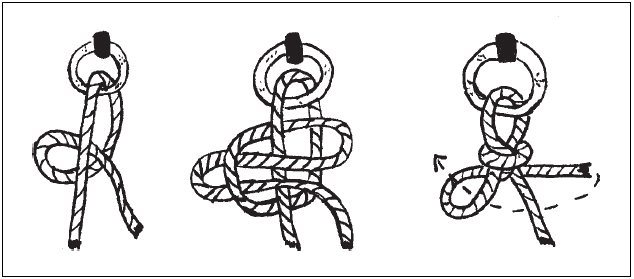
Figure 1. Quick release knot.
Traveling Safety
- Most horses take to trailering naturally, while for others it is often a traumatic experience. It is important that a horse be happy and secure when being trailered. One bad experience in trailering is all it takes to make a horse a bad hauler. A bad hauler is hard to cure.
- Before traveling, check to see that the horse is comfortable and that ventilation is adequate. The hay bag or manger should be securely fastened so that the horse cannot become tangled in it.
- Test all doors to make sure they are secure, and check that the hitch is tight. Safety chains should be in place and all lights and brakes should be functioning in accordance with your state's Division of Motor Vehicles codes.
- Turns, starts, and stops should be very slow and steady.
- Do not exceed the speed limit. Remember to allow extra stopping distance when towing a trailer. Moving horses and the weight of the trailer will push against the towing vehicle.
- Do not allow anyone to throw lit cigarettes or matches from the window of the towing vehicle. Wind currents often suck the cigarettes or matches into the trailer, causing a fire.
- Check on the horse(s) at every stop or every 100 miles. At this time also check the hitch, safety chains, lights and hay bags. Keep hay bags full and offer the horse(s) a drink of water.
- Avoid backing up with the trailer if at all possible. If backing up is necessary it is advisable to have a person outside the vehicle to watch and guide you.
Unloading the Horse
- When lowering the ramp, keep feet and hands out of the way.
- Untie the horse before lowering the butt bar.
- Do not stand on the ramp or directly behind the trailer when a horse is exiting in case it leaves the trailer quickly. It is not advisable to allow a horse to fly back quickly as this soon becomes a bad and dangerous habit.
- Try to keep the horse straight as it backs down the ramp so that it does not step off the side. Walk the horse around after trailering for an extended distance to restore circulation and ease stiff muscles.
Other Safety Precautions
- The ramp to the trailer should be in an up position when tying a horse to the outside of the trailer, especially when the tie rings are located towards the rear. A ramp in the down position leaves space between the back of the trailer and the springs where a horse can easily get a foot or leg stuck. The ramp is also the right height on which the horse could injure its lower legs.
- Never leave a horse tied to the outside of a trailer unattended. When leaving a horse inside a trailer, make sure the chest bar and butt bar are secure, especially if an escape door is left open.
Trailering your horse is often a necessity and should be an uneventful experience. As long as common sense is used and the safety guidelines above are followed, trailering accidents are less likely to occur.
References
- Are the Trailer and Horse Road Worthy. October 2003. Miller, R. Equus Magazine.
- Are You Keeping Up with Vaccinations and Coggins Testing? July 2016. Rutgers Equine Science Center.
- Basic Horse Safety Manual. American Youth Horse Council in Cooperation with the American Horse Council. 1989.
- Dehydration, stress, and water consumption of horses during long-distance commercial transport. 2000. Friend, T.H. Journal of Animal Science 78:2568–2580
- Horse Trailering Tips, November 2014. Meadows, D. and Henton, J. eXtension.
- Knot Tying: Quick Release Slip Knot, February 2015. eXtension.
- Trailer Loading Stress in Horses: Behavioral and Physiological Effects of Nonaversive Training (TTEAM). 2003. Shanahan, S. Journal of Applied Animal Welfare Science 6: 263-274.
- Trailer Safety Checklist. May 1990. Hayes, K. Equus Magazine.
- Traveling With Your Horse, November 2014. Meadows, D., Henton, J and Gill, W. eXtension.
- Physiological responses of horses to 24 hours of transportation using a commercial van during summer conditions. 2000. Stull, C. and A.L. Rodiek. Journal of Animal Science 78: 1458–1466.
This publication was made possible in part by a grant from the National Institute for Occupational Safety and Health Program on Agricultural Health Promotion Systems for New Jersey.
June 2019
Copyright © Rutgers, The State University of New Jersey. All rights reserved.
For more information: extension.rutgers.edu.
Cooperating Agencies: Rutgers, The State University of New Jersey, U.S. Department of Agriculture, and Boards of County Commissioners. Rutgers Cooperative Extension, a unit of the Rutgers New Jersey Agricultural Experiment Station, is an equal opportunity program provider and employer.