
Fact Sheet FS1152
Hydrangea
Hydrangeas are great plants for the garden whose many benefits have been well recognized by gardeners over the centuries. They provide floral and occasionally foliar interest beginning in late spring or early summer that often persists well into autumn. On the whole, they are also a very easy group of plants to grow, providing a great degree of satisfaction with minimal effort. The one requirement shared among the various species is the need for consistent moisture throughout the growing season. Curiously, water is also reflected in the genus name, as Hydrangea is derived from the Greek Hydor, meaning water and Angos, meaning vessel or jar. Thus, the direct translation would be water jar and was inspired by the shape of the seed capsules, which resemble miniature Grecian water jars.
Of the roughly seventy species that exist in North and South America and in Asia, only five are used extensively as ornamentals. Each of the five have slightly unique cultural needs to produce a healthy, flowering shrub, although all benefit from a moist, humus-rich soil. The one cultural practice that continually prompts the most questions is how the plants should be pruned. The confusion arises based on the timing of the flower bud formation. Some species produce flower buds during the fall of the previous year, which persist through the winter before opening the following June. Other species produce flower buds during the spring, which subsequently open a few months later. Obviously, if a plant is pruned back severely in the winter and the flower buds were set the preceding fall, the flower buds will be removed, and flowering will be impacted or eliminated for that season. One clue to help understand how and when to prune is to recognize where in the world the plant naturally grows. Those native to colder climates produce flower buds on new growth while those native to warmer climates form flowers on previous year’s growth. From the standpoint of survival, this makes perfect sense since if a stem was killed to the ground during an exceptionally cold or damaging winter, the plant would still be able to flower and reproduce.
Hydrangea arborescence – Smooth Hydrangea
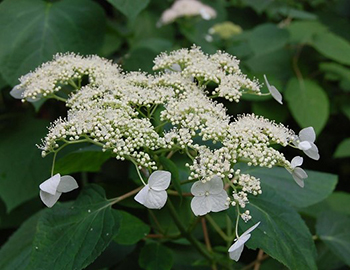
Figure 1. Smooth Hydrangea.
Native to the Eastern United States, this species grows to 3–5’ in height with an equal or greater spread. The branching habit of mature specimens often resembles that of a tree. The foliage ranges from 2–6” long and is dark green on top and green, pale green or silver below. The flowers are arranged in a structure called a cyme that consists of a central flat boss of sterile flowers surrounded by a ring of showy sterile white florets. The mission of the sterile florets is to attract pollinators. Since the anthers of the fertile florets visually create a very lacey appearance, it is referred to as a Lacecap flower. There are several selections that feature large showy globes of mostly sterile florets; these are referred to as Mophead or Hortensia flowers. Although they are far showier, they provide little benefit to our pollinators due to the lack of fertile florets. Flowering starts in mid- to late June with the flowers transitioning to green by August and finally tan by fall. The color spectrum for the flower has been expanded in recent years with a number of pink-flowered selections. The flowers for this species occur on new growth, allowing the plant to be cut to the ground in late fall or winter. In fact, the stems often snap under snow load, and cutting the plant to the ground will often improve the appearance of the winter garden and yield a better-looking plant for the season to come. Plants prefer part shade but will tolerate full sun if the moisture remains constant. In the wild, they often grow out of crevices in moist and shady stone cliffs, as can be witnessed at the Delaware Water Gap in New Jersey. Plants are hardy through Zones 4–9.
Selections Available
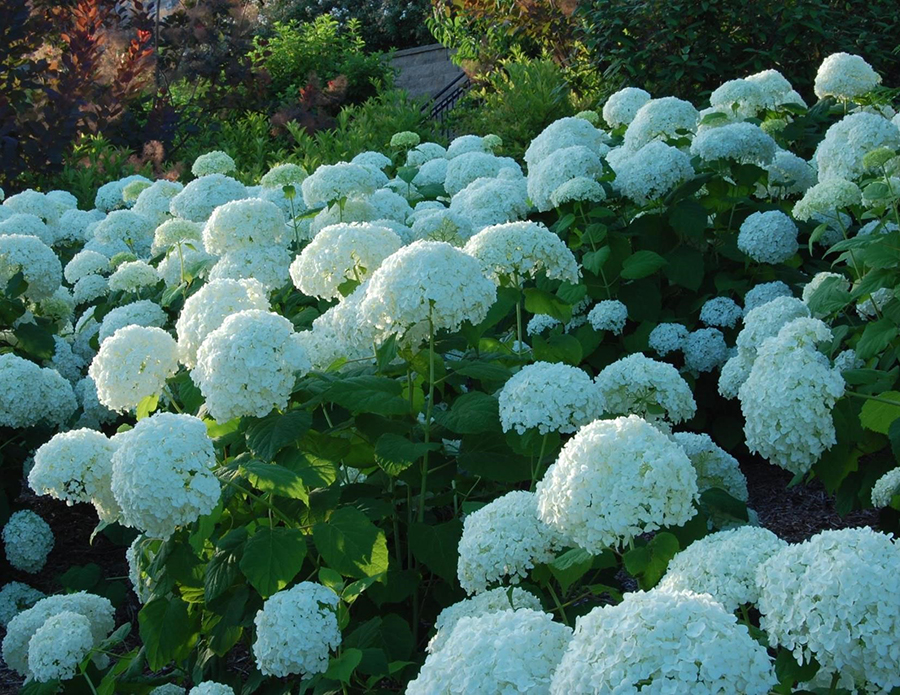
Figure 2. 'Annabelle' Hydrangea.
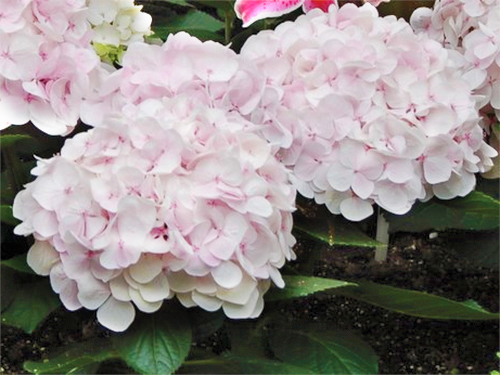
- ‘Annabelle’: Large corymbs forming globe-shaped or mophead flowers up to 12” across. Unfortunately, when the weight of the flower heads becomes excessive following a rainstorm, the stems often bend, dropping the flower on the ground. This trait is exacerbated if the plants are fertilized. The dried flowers look great in the fall and winter. It is best to cut the stems back hard in late winter. For an interesting display of globe-shaped flowers in June, pair the plant with the ornamental onion, Allium ‘Gladiator’ that has large purple flowers.
- ‘Grandiflora’: An old-fashioned form with mophead flowers of sterile florets up to 6–8” in diameter. The flowers are not as uniform as ‘Annabelle’ and have a somewhat lumpy appearance.
- ‘Haas Hallo’: Selected by Rick Ray of Pennsylvania from seeds given to him by Joan Haas. This lace cap form features exceptionally large flowers, reaching upwards of 14” in diameter on strong stems.
- Incrediball®: Similar to Annabelle, but the flowers are slightly larger with stronger stems, reducing the chance of the flower stems flopping over as easily.
- Incrediball® Blush™: Flowers are similar in size and form to Incrediball®, with an evolving flower color that starts out as a light pink, transitioning to a deeper pink before turning green by autumn.
- Invincibelle® Spirit II: The misspelling of invincible is correct. This form is an improvement of the original release as it features deeper pink dome-shaped flowers with stiffer stems. The flowers are typically not as large as the white selections but can reach upwards of 6–8” in diameter. One dollar from the sale of each plant supports breast cancer research. Bred by Tom Ranney at North Carolina State University.
- White Dome®: A lace cap form that yields 6–10” diameter domes of fertile florets, surrounded by an outer ring of showy white sterile florets that transition to green by August. Good for pollinators.
Hydrangea macrophylla – Bigleaf Hydrangea
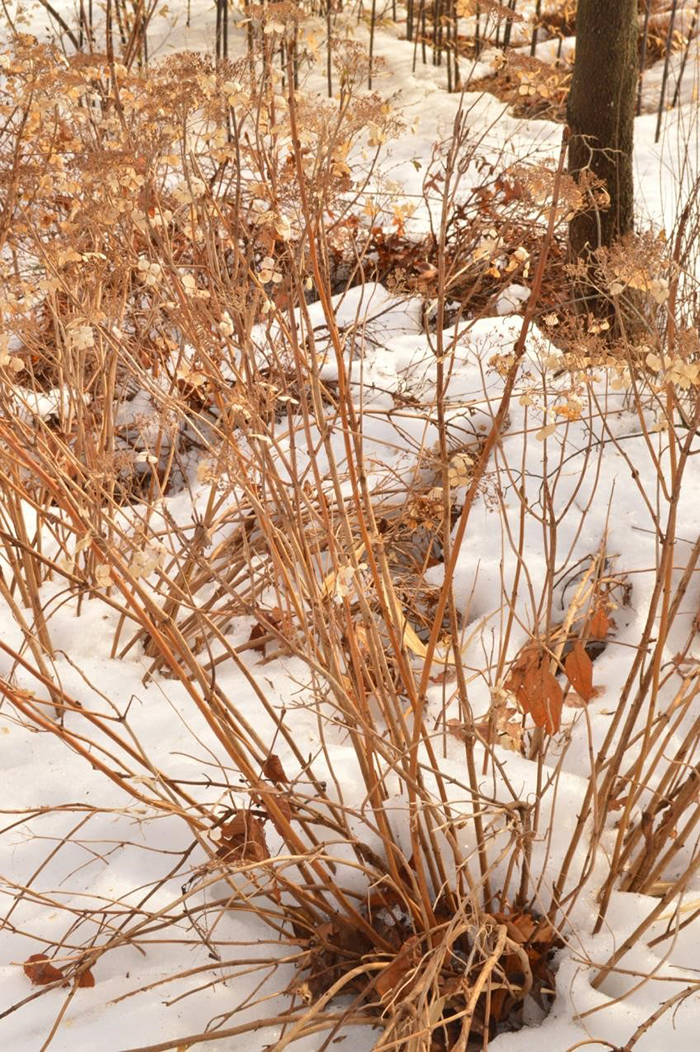
Figure 3. Winter - Bigleaf Hydrangea.
Bigleaf Hydrangea is the species that comes to most people’s minds when Hydrangeas are mentioned, with their attractive blue, pink, or occasionally white flowers. The glossy, deep green foliage is large, reaching upwards of 8” long, inspiring both the common name and species epithet. They are native to the eastern Himalayas and western China, east to the coastal and milder regions of Korea and Japan. With such a vast native area, it is not surprising to find such a tremendous variation within the species in regard to flower shape and color, as well as the size and hardiness of the plants. In fact, there are several hundred cultivars. The challenge for gardeners is the hardiness of the flower buds since they are formed during the fall of the preceding year. For those cultivars native to southern regions of Japan, the flower buds and even the stems can be damaged by cold temperatures, eliminating flowering potential. The Endless Summer series is unique since they produce flower buds on both the previous and current year’s growth. However, if the preceding year’s stems are killed to the ground, the new stems that emerge from the base do not yield any flowers. It is only the new growth produced from the existing stems that will develop flower buds for late summer and fall display. In cultivation, the plants generally grow to 3–5’ tall, although in the wild, they can reach heights to upwards of 15’!
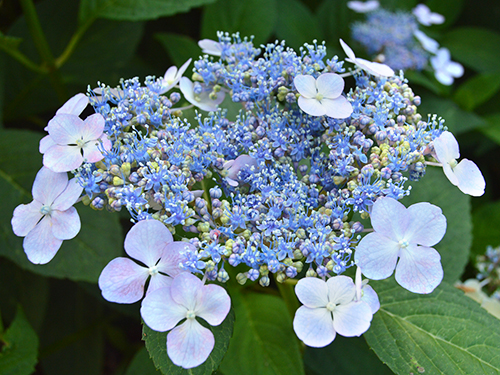
Following several centuries of selections based upon floral shape and color and several hundred cultivars, this species is much better divided by flower structure than Hydrangea arborescens into the Hortensia or Mophead and the Lacecap groups. In general, the Hortensia group works well in a garden where the plants are viewed from a distance, while the intricate detail of the Lacecaps are better appreciated up close. The Lacecap group also works better with other flowering plants and is ideal for the mixed border. Flowers of both groups can be pink or blue, which is caused by a pigment called Anthocyanin. Anthocyanin actually changes color depending upon the pH of the soil; in acid conditions it is blue, if neutral it is violet and if alkaline it is red. Consequently, a soil pH of 6.0–7.0+ results in Bigleaf Hydrangeas having pink flowers, while values below 6.0 results in blue flowers. Interestingly, pink and blue flowers can exist at the same time on one plant - if the roots that support a given number of stems of one plant are growing in soils with a different pH, the flowers of those stems will differ in color. This is more frequently seen next to a building, where the alkalinity of the foundation will impact the stems on that ‘side’ of the plant. Adding further confusion to this species, some of the selections have white flowers, regardless of the pH!
Pruning of Bigleaf Hydrangeas is best done during the winter months by removing the oldest stems. The youngest stems will be light brown in color with no side branches – they should always be left, as they will yield the largest flowers. Stems that are older than one year are gray in color and are branched. After four to six years of growth, these older stems produce smaller flowers and should be cut back to 1–2” above the ground along with any dead stems, stimulating the production of new stems from the base. For the Endless Summer Series, it is still best to thin the plant and remove the oldest and least productive stems. Pruning of Bigleaf Hydrangeas is often rather tedious work, but fortunately, it need not be done all in one day. As weather permits throughout February and into March, prune a few plants a day as time permits, preventing it from becoming an arduous chore! Some authorities suggest shearing the plants right after blooming, but for many, the flowers still look attractive in the late summer into fall and shearing would remove that interest.
Plants are best located in partial shade, although they are very tolerant of full sun providing the soil does not become excessively dry. Plants perform very admirably near ocean shorelines, a testament to where the plant is often found growing in Asia. Although this species is not noted for fall color, some selections do exhibit attractive yellows and red highlights and mix well with Amsonia hubrichtii (Blue Star Amsonia) and Itea virginica ‘Henry’s Garnet’ (Virginia Sweetspire). Winter hardiness varies, depending upon the native provenance, with hardiest forms surviving zone 6 winters.
Selections Available
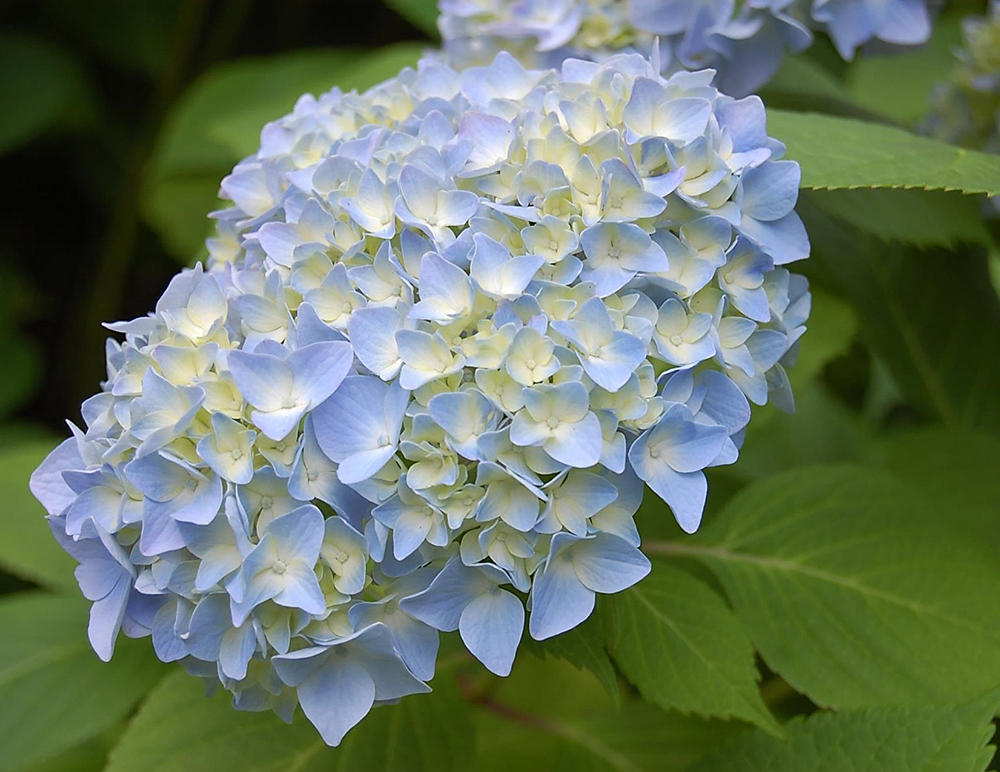
Figure 4. 'Nikko Blue' Hydrangea.
- ‘Blue Wave’: One of the hardiest of the Lacecaps, with the flowers fading to pink as they age. Appreciates shade during the hottest part of the day. Yellow fall color with touches of red.
- ‘Coerulea Lace’: Lacecap flowers with deep blue fertile flowers in the center, surrounded by blue or white sterile florets.
- Double Delights™ Wedding Gown: White Lacecap flowers that begin as green flowers in May, transition to white during June. The sterile florets are double, adding a new dimension to the flowers.
- Endless Summer®: Reblooming pink or blue Hortensia flowers on 4–5’ tall and wide plant.
- ‘Glowing Embers’: Crimson Purple Hortensia flowers over rich, dark green foliage. Grows to 4’ tall and wide.
- ‘Madame Emile Mouillère’: Introduced in 1909. White Hortensia flowers with scalloped edges to the florets. Grows to 5–6’ tall and wide.
- ‘Nikko Blue’: Large blue Mophead flowers that start out light green and transition to blue. Five feet tall and wide.
- ‘Pia’: Red Mophead flowers that appear on a more compact plant, only growing to 3–4’ wide and tall.
- Next Generation® Pistachio: Repeat blooming Hortensia flowers with the showy florets having a red center and a lime green border.
- ‘Tokyo Delight’: Lacecap flowers that are either pink or blue, depending on the soil pH. Growing 3–4’ tall and wide.
- ‘Twist ‘n Shout®: Part of the Endless Summer® series. Reblooming, deep pink Lacecap flowers with red stems.
- ‘Variegata’: White margins along the leaf, but not reliably stem and flower bud hardy in central New Jersey.
Hydrangea paniculata – Panicle Hydrangea
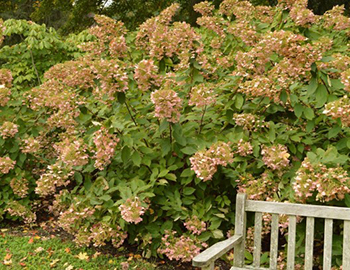
Figure 5. Quickfire® Hydrangea.
The Panicle Hydrangea is also native to Japan and China. However, unlike its cousin Bigleaf Hydrangea, this Hydrangea is found growing in much colder locations at elevations of up to 4,000 feet. Consequently, the adaptation to these colder environs correlates with its ability to produce blooms on current year’s growth. If left unpruned, this species becomes a large plant and even approaches small tree status of 15–20’ in height with an equal spread. In the wild, specimens can approach 25’ in height! However, they can easily be pruned on an annual basis to keep them to more manageable sizes, although the type or amount of pruning is actually based upon the type of flower the plant exhibits.
Panicle Hydrangea gets its name from the large white cone-shaped flowers, whose structure is botanically known as a panicle. A panicle consists of a central stem from which short branches project that terminate in the flowers. The panicles appear at the tips of the stems and range from 6” to over 12” long by 4” to 8” wide at the base, depending on the cultivar and how the plant is pruned. The outermost flowers are the showy sterile florets, with the fertile flowers located inside the ‘cone’, closer to the central stem. In general, there are two different forms of panicles found within this species: those with a very airy and open structure that have fewer sterile florets, versus those with an immense number of sterile florets, allowing the flower to resemble a cone of vanilla ice cream. The density of the sterile florets determines how the plant can potentially be pruned – either pruned back hard with stems cut close to the ground or to a ‘framework’ of stems.
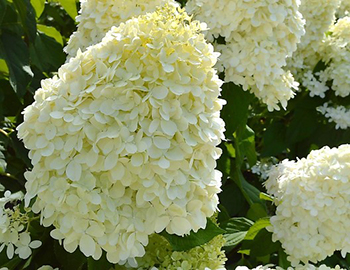
Figure 6. 'Limelight' Hydrangea.
If the stems are pruned back hard in the late winter to 6–18” tall, this will encourage vigorously growing new stems to emerge that often stretch to 8’ tall with much larger than normal flower panicles appearing at the end of the stem. The plants can also be pruned back lightly to a core framework of stems that is 3–5’ tall, resulting in only 2–3’ of new growth and a terminal flower. The long stems that result from a hard pruning are much less rigid and if the apical flowers are dense with sterile florets, the stem will bend to the ground during the first heavy rain under the weight of the flower. The open panicle flowers are obviously far less weighty and can be supported by the longer stems. Thus, plants with dense flowers should be cut back to a framework, allowing the flowers to remain upright with an attractive presentation to the viewer. Plants with open flowers and less sterile florets can be cut back hard or to a framework, depending upon the gardener’s choice, as both techniques will result in a good presentation of the flowers.
For many of the selections mentioned below, the flowers will transition from white in July, to pink in September and October, to tan by December. Some people find the winter aspect of the flowers to be unappealing, but with a snowy background, they can add an interesting winter texture and form to the landscape. Fall color of the foliage is typically yellow. The plants are best grown in full sun or partial shade, in moist but well-drained soils. This species has definitely come into its own of late with an incredible number of new cultivars becoming available for purchase. Plants are hardy from Zone 3–8.
Selections Available
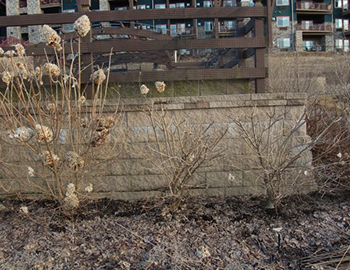
Figure 7. Pruning dense flowered forms to a framework.
- ‘Bobo’: A compact plant, grows to 4–5’ tall with dense white flower ranging from 4–6” in length.
- ‘Brussels Lace’: Grows to 6–8’ tall, with large and very open flowers and few sterile florets. The anthers protrude from the beige fertile flowers, imparting a very lacey effect. On average, flowers grow 8–12” long.
- ‘Dharuma’: Another dwarf form, to 5’ tall. Flowers appear very early and quickly fade from white to pink to brown by September. Ideal for the small home garden with panicles that reach 4–6” long. Oddly, when this selection is cut back hard in spring, it produces very attractive glossy foliage with few blooms the first year.
- ‘Fire and Ice’: Grows to 10–12’ tall, the open panicles quickly transition from white to a nice red by the end of July. Flowers average 5–7” in length.
- ‘Grandiflora’ (‘Pee-Gee’): Flowers are more spherical and dense, consisting of mostly sterile florets. Flowers average 5–6” in length and remain attractive for an extended period, turning pink in late summer and finally brown in September and October. Introduced during the 1860’s, this was the classic Hydrangea of Victorian times. A very vigorous plant, it should not be cut back severely in late winter as the heavy flowers will cause the stems to flex and drop the flower to the ground. If left unpruned, it can reach heights of 15–18 (20’) tall.
- ‘Limelight’: Lime green flowers in June turn to white in July into August and finally pink by September. A vigorous selection easily grows to 10–12+’ tall. Very dense flowers averaging 5–6” long that weigh down the stems if vigorously pruned in winter.
- Little Quick Fire®: Flowers are similar to Quick Fire® (see below), but it grows to a more demure height of 4’ tall.
- Little Lime™: Large flowers similar in shape and size of Limelight, on a more compact plant reaching 4–5’ tall.
- ‘Pinky Winky’: Older florets quickly fade to pink while the panicle continues to grow and produce new white florets at the tip, creating an attractive bi-color effect. In keeping with the ice cream comparison it is reminiscent of strawberry ice cream with whipped cream on top. By autumn, the 5–7” long flowers have entirely changed to pink and remain attractive through October.
- Quick Fire® (‘Bulk’): Grows to 8–10’ tall, it produces open panicles on red stems that rapidly fade from white to pink. Flowers are 5–7” in length and the red coloration becomes more enhanced with cooler summer temperatures. The more northern your garden is located, the more dramatic the pink coloration will become.
- ‘Tardiva’: Large open flowers in late July through fall—looks nice paired with Clematis tibetana and Lespedeza ‘Gibraltar’.
- ‘Unique’: Vigorous growing plant to 15’ tall with proportionately large white panicles, 8–10” in length that change to pink by autumn. Flower panicles are very open, allowing the plant to be pruned heavily in winter.
Hydrangea quercifolia – Oakleaf Hydrangea
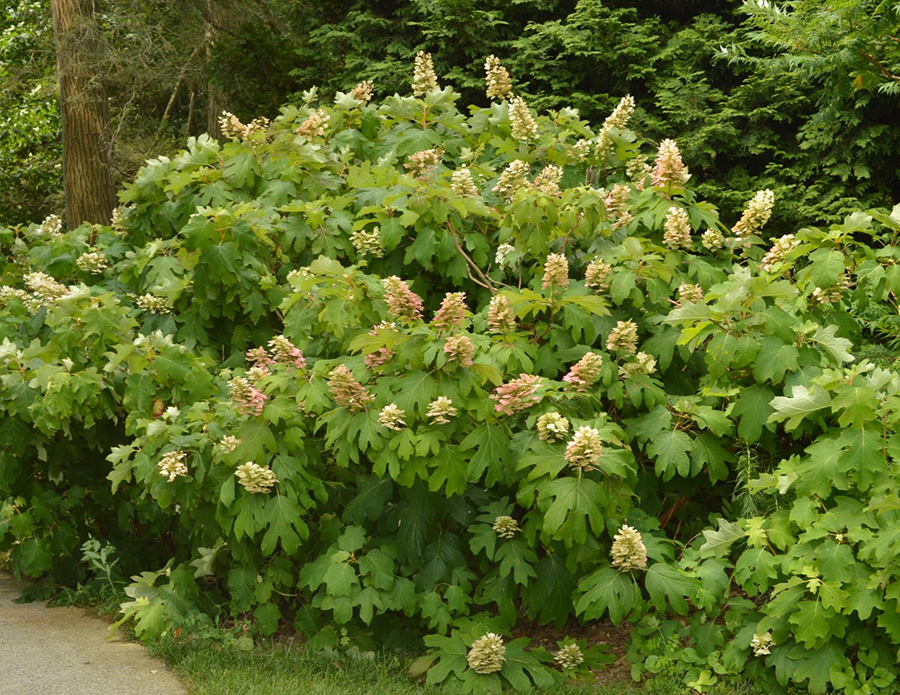
Figure 8. Oakleaf Hydrangea.
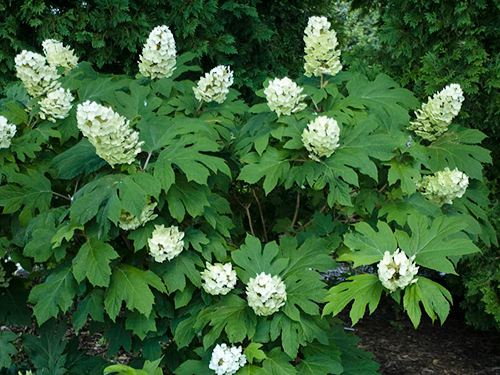
Fortunately, most gardeners now see the beauty in this native of moist woodlands and streambanks of Louisiana, Alabama, Georgia, and Florida. In fact, with its wonderfully bold foliage, attractive flowers, great fall color, and interesting bark, what is not to like?
The foliage resembles that of an oak providing the inspiration for both the species epithet – Quercus is the genus for oak – and the common name. Like Hydrangea paniculata, the white flowers are also panicles ranging from 4” to 12” in length. The flowers typically appear in late June through July, with some selections transitioning to pink by August and September while other forms simply turn brown. As one might suspect, its warm southern origins foretells that the flower buds are formed on the previous year’s growth. Of all the Hydrangeas mentioned, this is the most challenging to prune and really should be planted in a location where it can simply be allowed to grow. Unexpected by most gardeners, the plants can reach heights of 8–10’ with greater spread since the plants sucker, making this a poor selection for in front of the living room window. Rather, it should be planted in a woodland garden or off the corner of a building. Any attempt to reduce the size of the plant will eliminate the current year’s flowers. Heavy pruning also proves to be futile as the plants are vigorous and will regrow to their original size within a few years. If the location requires a smaller plant, consider the more compact growing forms.
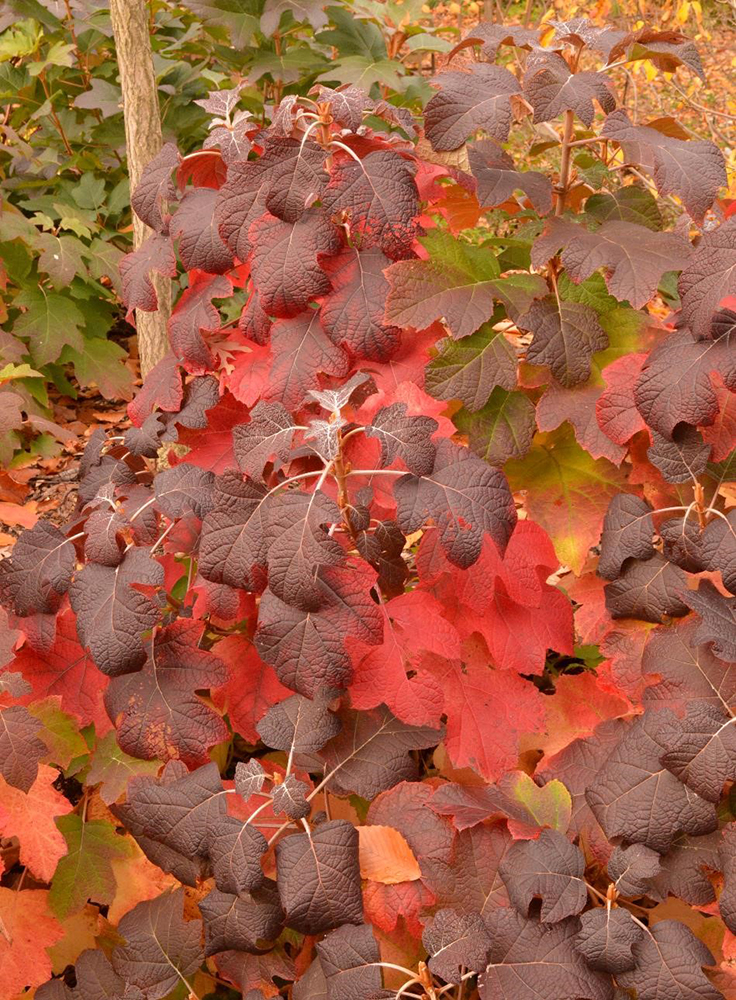
Figure 9. Fall color Oakleaf Hydrangea.
Foliage is a rich green in summer, turning to simmering reds, oranges, and yellows in the fall, often persisting into January. Stems have peeling tan bark, which is attractive to plant aficionados, but often unrecognized. Most vigorous growth occurs in light shade with moist, humus rich soils. Although it is native to a warmer climate, it is surprisingly hardy throughout much of NJ. Flowers buds are hardy to roughly –5 degrees F. although the plants will survive colder temperatures. Oak Leaf Hydrangea is drought-tolerant once established and although it is far from weedy, one of the authors has noticed self-sown seedlings appearing in rocky crevices or cracks in masonry work. Plants are hardy from Zones 5–9.
Selections Available
- ‘Alice’: A very vigorous growing plant that can reach heights and widths of 12’. Equally robust flowers, 10–14” long adorn the plant with the individual sterile florets reaching over 1” in diameter. Flowers mature to a rosy pink by late summer and the foliage exhibits good burgundy red fall color.
- Gatsby Pink®: Produces white flowers that quickly transition to pink by August, with mahogany red fall color.
- ‘Little Honey’: A yellow foliaged sport of ‘Pee Wee’. This form does not need to flower in order to brighten a shady location.
- ‘Pee Wee’: Dwarf form to 3–4’ tall. The plant has a very attractive habit and could create a rather interesting, if not unconventional taller groundcover. The flowers fade to tan by September with good reddish purple fall color.
- ‘Ruby Slippers’: Large, 9” long flower panicles open white and quickly turn to pink, darkening to a dark rose by summer’s end. Only grows to 3–4’ tall by 4–5’ wide, with good mahogany red fall color, making it a perfect choice for that location below that living room window.
- ‘Snow Queen’: A Princeton Nursery introduction, the flowers are held upright, with a greater number of sterile florets resulting in a very attractive floral display. Superior bud hardiness and incredible displays of red, orange and yellow autumn colors. Ultimately grows to 8’ tall and wide.
- ‘Snowflake’: Multiple bracts appear on the top of those previously formed, producing a double (hose-in-hose) appearance. This form tolerates heavy shade. Flower panicles are so heavy they typically dangle down under their own weight, which may not appear attractive to some gardeners.
Hydrangea serrata (Hydrangea macrophylla subspecies serrata) – Mountain Hydrangea
Similar to Hydrangea macrophylla, it is smaller in habit (2–4’ tall) and typically more bud and stem hardy due to its native habitat in colder, mountainous locations. The smaller leaves are serrated with saw-tooth edges to the leaves that led to the species name. Lacecap flowers are produced on new and old wood, resulting in flower production from June to frost following an average winter. Flower color varies from red to blue, once again influenced by the soil pH. Plants are hardy from zones 6 through 7. It can potentially survive a zone 5 winter if it is sited properly.
Selections Available
- ‘Canyon Blue’: Grows to around 3’ in height with Lacecap flowers.
- ‘Grayswood’: A taller form of Mountain Hydrangea, grows to 6’ tall. Appears rather leggy when first planted but fills out as the plant matures. Sterile florets are initially white, turning to pink or blue with age.
- ‘Preziosa’: Flowers start pink, and deepen with age, remaining red even on acidic soils. Flowers resemble small Mophead flowers, although there are ample fertile florets located beneath and between the sterile florets.
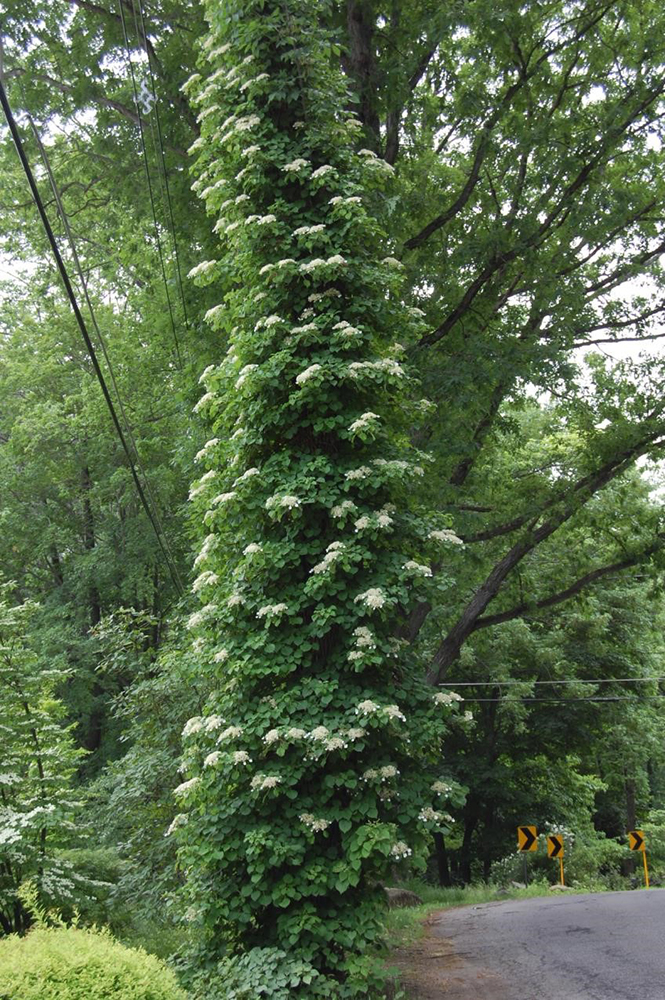
Figure 10. Climbing Hydrangea.
Hydrangea anomala subspecies petiolaris – Climbing Hydrangea
Overlooked by many gardeners, this Hydrangea provides additional design solutions the previously described species cannot deliver. Climbing Hydrangea is a true clinging vine, attaching to surfaces by root-like holdfasts and can easily grow to 50’+. It can be grown on stone or brick masonry or up tree trunks. A common question is whether it damages masonry or in some manner harms trees. So long as the masonry employs modern cement-based versus lime-based mortars, and the trees are in good health, no damage will result. However, the vines will damage clapboard or wooden-sided structures. The vines will not attach or cling to cement plastered walls or to cultured (artificial) stone.
Dark green foliage is the backdrop for 6–10” diameter white Lacecap flowers in June. Flowers appear on stems that project outwards from the vine and are effective for about two weeks. Fall color is an attractive clear yellow, typically with a green margin. Stems are an attractive cinnamon brown in color with trails of exfoliating bark. Plants require well-drained soils and are slow to become established and flower, which is often a complaint among gardeners. Once established, the vines will grow vigorously and require little pruning other than restricting growth from where it is not wanted. Plants are hardy to Zone 4, but some vines appear less hardy than others. ‘Skylands Giant’ reportedly has larger flowers.
Schizophragma hydrangeoides – Japanese Hydrangea Vine
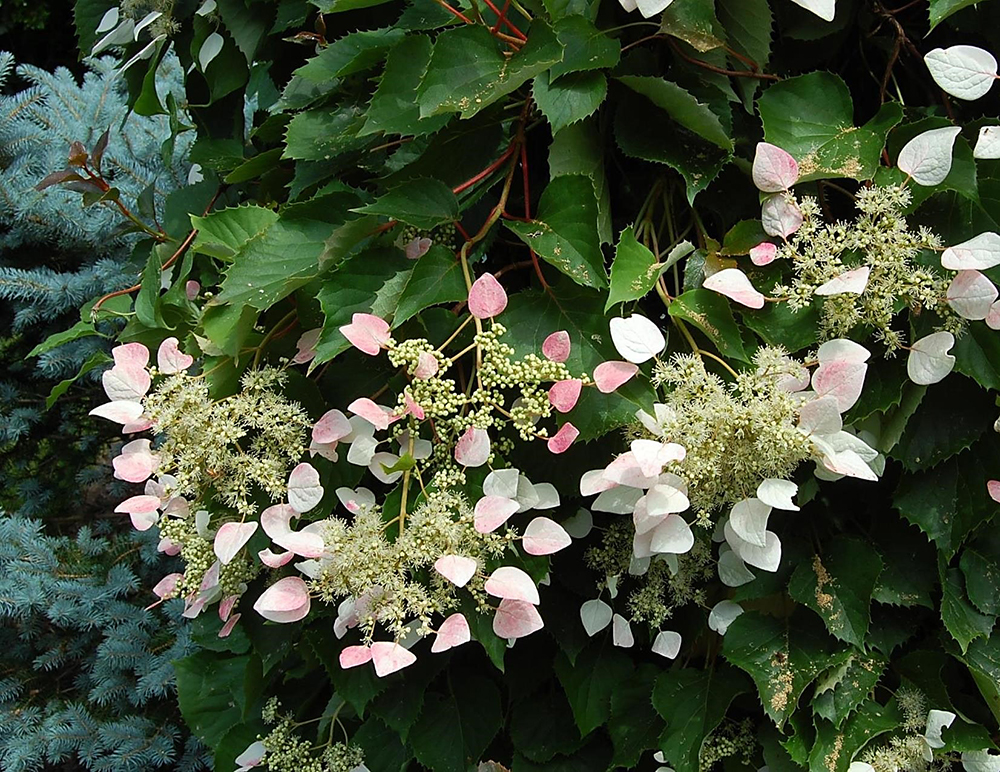
Figure 11. 'Roseum' Japanese Hydrangea Vine.
Beginning to be seen in more and more nurseries, Japanese Hydrangea Vine is a close relative of Hydrangea and very similar to Climbing Hydrangea Vine. The plants also attach by root-like holdfasts, although it is not as densely clothed with leaves, providing a more open appearance. The flowers appear in mid- to late June, just as those of H. anomala var. petiolaris are fading, making it a nice companion planting. Probably the most noticeable difference between the two vines is the shape of the sterile florets. Those of Climbing Hydrangea Vine are arranged in whorls of 3, 4 or 5, while on Japanese Hydrangea Vine, it is simply one large spade-shaped sepal. A vigorous vine, it matures to a more diminutives height of around 30’, thriving in well-drained soils in part shade. Plants are hardy from Zones 5–7.
Selections Available
- ‘Moonlight’: Foliage has dark green veins with silvery mottling in between the veins, giving it the appearance that it is being illuminated by moonlight.
- ‘Roseum’: Red leaf petioles and dark green leaves, combined with fragrant, light pink Lacecap flowers. A very underused yet wonderful garden plant.
Best Practices for Pruning Hydrangeas
When it comes to pruning Hydrangeas, timing is everything. The right time to prune a Hydrangea depends on the species, the time of year it sets flower buds, and if the flower buds are formed on older stems or on new growth stems. If you prune a Hydrangea at the wrong time of year, you will remove the flower buds that will produce blooms in the current or next year.
The first step to understanding correct pruning practices is to identify the type of Hydrangea you have and perform proper pruning practices at the right time of year.
| Hydrangea Species | Bud Formation | When/How to Prune |
|---|---|---|
| Hydrangea arborescens (Common names: Smooth or Wild Hydrangea) | Buds set on new stems in spring |
|
| Hydrangea macrophylla (Common names: Bigleaf, Mophead, Florist, and Hortensia Hydrangea) | Buds set on old stems in mid-summer through fall |
|
| Hydrangea macrophylla (Common name: Lacecap Hydrangea) | Buds set on old stems in mid-summer through fall |
|
| Hydrangea paniculata (Common name: Panicle Hydrangea) | Buds set on new stems in spring |
|
| Hydrangea quercifolia (Common name: Oakleaf Hydrangea) | Buds set on old stems in mid-summer |
|
| Hydrangea serrata (Hydrangea macrophylla subspecies serrata) (Common name: Mountain Hydrangea) | Buds set on old stems OR old and new stems |
|
| Hydrangea anomala subsp. petiolaris (Common name: Climbing Hydrangea) | Buds set on old stems in mid-summer |
|
| Schizophragma hydrangeoides (Common name: Japanese Hydrangea Vine) | Buds set on old stems in mid-summer |
|
Mention or display of a trademark, proprietary product, or firm in text or figures does not constitute an endorsement by Rutgers Cooperative Extension and does not imply approval to the exclusion of other suitable products or firms.
September 2020
Copyright © Rutgers, The State University of New Jersey. All rights reserved.
For more information: extension.rutgers.edu.
Cooperating Agencies: Rutgers, The State University of New Jersey, U.S. Department of Agriculture, and Boards of County Commissioners. Rutgers Cooperative Extension, a unit of the Rutgers New Jersey Agricultural Experiment Station, is an equal opportunity program provider and employer.